How We Diagnose AdBlue Faults Without Guesswork
AdBlue repairs fail when diagnosis is rushed. This post explains the step-by-step process we use to find the real fault before any repair starts.
Most AdBlue faults are not complicated. What makes them expensive is guessing. A warning message gets cleared, a part gets changed, and the fault comes back a week later.
We avoid that by following a structured diagnosis every time. The goal is simple. Prove what has failed and why before touching the repair.
Guesswork usually leads to
- • Replacing tanks that were not faulty
- • Replacing sensors that were reading correctly
- • Clearing codes without fixing the cause
- • Countdown warnings returning weeks later
Diagnosis is not a single scan. It is a process.
Step 1: Confirm the exact warning and behaviour
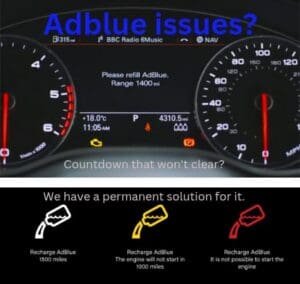
We start with what the vehicle is telling you, not what someone thinks it means. The wording of the message matters.
- Exact dash message and symbols.
- Whether a countdown is active.
- When it first appeared.
- What changed before it appeared.
A “top up AdBlue” warning behaves very differently to an SCR efficiency fault.
Step 2: Read fault codes with context
Fault codes alone are not enough. We read freeze-frame data to see what the engine and SCR system were doing when the fault was logged.
We look for patterns like
- Faults that only occur cold.
- Faults that occur after dosing events.
- Multiple SCR-related codes together.
- Repeated faults under similar conditions.
Step 3: Check live data, not just stored faults
Live data shows what the system is doing now. This is where many misdiagnoses are avoided.
AdBlue level and temperature
We confirm readings make sense and change when they should.
NOx sensor values
We check for drift, spikes, or impossible readings.
SCR efficiency signals
We confirm whether dosing is actually reducing emissions.
Step 4: Physical inspection for real-world issues
Software cannot see everything. Many AdBlue faults are caused by physical problems.
- Crystallisation around injectors or joints.
- Leaks or staining around hoses.
- Corroded or wet connectors.
- Damage from road debris.
Step 5: Decide the repair based on evidence
Once the fault path is proven, the repair becomes clear. This is where time and money are saved.
- Repair where the fault is confirmed.
- Replace only what has failed.
- Validate the fix before finishing.
Stop guessing. Get a confirmed answer.
If your AdBlue warning keeps returning, we can diagnose it properly and fix the real cause.
Mobile service across the West Midlands and surrounding areas.
AdBlue diagnosis FAQs
Why do AdBlue repairs often fail?
Because the underlying fault was not proven before parts were replaced or codes cleared.
Is diagnostics worth it?
Yes. Proper diagnosis often costs less than replacing the wrong part once.
Can you diagnose on a mobile visit?
Yes. Most AdBlue faults can be diagnosed on-site without a workshop visit.