The Complete Guide to AdBlue Problems in 2026
AdBlue problems are now one of the most common reasons diesel vehicles enter limp mode or refuse to start. This guide explains warning lights, fault codes, countdown messages and the correct repair routes.
If you are seeing an AdBlue warning light, an SCR fault, or a countdown telling you the vehicle will not restart, you are not alone. Modern diesel systems are strict. When something in the AdBlue system stops working correctly, the vehicle reacts quickly.
The problem is not the warning itself. The problem is misdiagnosis. Tanks get replaced when sensors failed. Pumps get changed when wiring was at fault. Fault codes get cleared without solving the cause.
- What the AdBlue system actually does
- Common AdBlue warning lights and messages
- The most frequent AdBlue fault codes
- Why countdown messages appear
- Common physical failures
- Repair vs replacement decisions
What the AdBlue system actually does
AdBlue is used in the SCR (Selective Catalytic Reduction) system to reduce NOx emissions. The system injects AdBlue fluid into the exhaust stream. It reacts with exhaust gases and lowers emissions to meet legal standards.
Main components involved
- AdBlue tank with level and temperature sensors
- AdBlue pump and pressure system
- Dosing injector in the exhaust
- NOx sensors before and after the SCR catalyst
- SCR control logic inside the ECU
If any one of these fails, the system cannot confirm emissions control is working. That is when AdBlue problems begin.
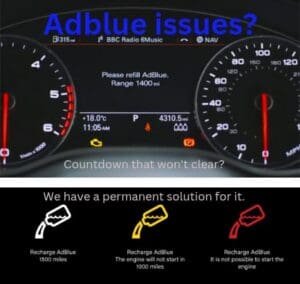
Common AdBlue warning lights and messages
Not all warnings mean the same thing. The wording matters.
- “Top up AdBlue” – usually just low fluid.
- “AdBlue system fault” – fault detected within SCR system.
- “Engine will not restart in 500 miles” – countdown triggered.
- Engine management light with SCR code – stored fault confirmed.
If the warning returns shortly after refilling, the issue is not fluid level. It is a system fault.
For a deeper breakdown of message types, see AdBlue countdown warning explained.
The most common AdBlue fault codes
Across many vehicles in 2026, we repeatedly see similar codes.
- P20E8 – AdBlue pressure too low
- P204F – Reductant system performance
- P20EE – SCR efficiency below threshold
- NOx sensor communication faults
These codes do not automatically mean the tank or pump has failed. They describe a condition. Diagnosis proves the cause.
Related: NOx sensor causing AdBlue faults
Why countdown messages appear
Countdown warnings are triggered when the ECU believes emissions control is compromised. The vehicle is programmed to prevent restart if the issue is ignored.
- The fault must be active and confirmed.
- The system must fail validation cycles.
- The ECU then initiates mileage restriction.
Clearing codes without solving the root cause often makes the countdown return.
See also: AdBlue start prevented message
Physical problems that cause AdBlue issues
- Crystallisation blocking injectors
- Split hoses or small leaks
- Corroded wiring connectors
- Failed tank internal sensors
- Pump pressure drop
Crystallisation is especially common in short-trip vehicles. For more detail, read AdBlue crystallisation explained.
Repair vs replacement: what actually makes sense
Not every AdBlue problem requires a full tank replacement. In many cases:
- Individual sensors can be repaired.
- Wiring faults can be resolved.
- Pressure faults can be traced to minor leaks.
Understanding the difference can save thousands. Compare options in AdBlue repair vs replacement.
If your AdBlue warning keeps returning
We provide structured mobile diagnostics across the West Midlands. The goal is simple: confirm the fault before recommending a repair.
AdBlue problems FAQs
Can I keep driving with an AdBlue fault?
Sometimes, but once a countdown begins, restart may be blocked.
Will topping up AdBlue fix the warning?
Only if the warning is genuinely low fluid. System faults will return.
Are AdBlue tank failures common?
Some vehicles suffer internal sensor faults, but tanks are often replaced unnecessarily.
Can AdBlue faults be diagnosed on-site?
Yes. Most diagnostics can be completed during a mobile visit.