Mobile AdBlue Diagnostics: What We Check Before Any Repair
AdBlue warnings are easy to misdiagnose. Before we repair anything, we test the system properly. This guide explains what we check on a mobile visit, what data matters, and why it stops repeat faults.
Most AdBlue problems are not fixed by guessing. One dashboard message can be caused by multiple faults, and one fault can trigger several messages. That is why diagnostics matter more than the first “part that seems likely”.
On a mobile visit, we focus on proving what has failed and why. When you know the fault path, the repair sticks.
Diagnostics helps you avoid
- • Replacing a tank when the issue is wiring or a sensor reading
- • Replacing a NOx sensor when the injector is blocked
- • Clearing faults that return the same week
- • Paying for a “fix” that never addressed the root cause
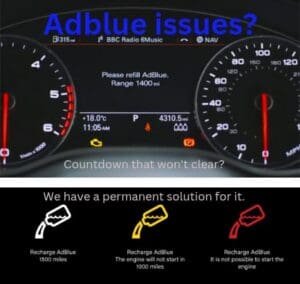
If you are already in a countdown, diagnostics becomes even more urgent.
Step 1: Confirm the exact warning and behaviour
We start with what you can see. The wording on the dash, how long it has been present, and what changed before it appeared.
Message type
“Top up AdBlue” behaves differently to “SCR fault” or a countdown warning.
Timeline
Did it start after a top-up, a long run, cold weather, or a garage visit?
Drive symptoms
Limp mode, poor fuel economy, or repeated warning cycles change what we check first.
If you are seeing “start prevented” warnings, this page breaks down what they mean:
AdBlue start prevented message.
Step 2: Read faults and freeze-frame data, not just codes
Codes matter, but they are only the start. Freeze-frame data shows the conditions when the fault was logged. That can reveal whether the issue happens under load, during warm-up, or only after a long drive.
We look for patterns like
- Fault repeats at the same temperature range
- Fault triggers during dosing events
- Fault appears after refuelling or topping up
- Multiple related faults logged together
A single code without context is how people end up replacing the wrong part.
Step 3: Live data checks across the SCR system
Live data is where most “mystery” AdBlue faults get solved. A sensor can appear fine on a basic scan but behave badly in real conditions.
AdBlue level and temperature
We check whether readings make sense and whether they change correctly after events.
NOx sensor behaviour
We compare expected values and look for drift, spikes, and impossible readings.
SCR efficiency signals
We look at whether the system is reducing emissions as it should when dosing occurs.
If your fault looks linked to NOx sensors, this page helps with symptoms and outcomes:
NOx sensor solutions.
Step 4: Physical checks for crystallisation, leaks, and blockages
Some faults are obvious once you look. Crystals, damp connectors, and leaks can trigger repeated warnings even if the scan looks “clean”.
We check areas like
- Filler area and tank joints for crystals or staining
- Injector area for crusting and restriction
- Hoses and couplers for seepage
- Connectors for corrosion or water ingress
For a dedicated guide on crystals and why they keep coming back, read:
AdBlue crystallisation.
Step 5: Decide the repair based on evidence
Once we know what is wrong, the repair becomes straightforward. This is the point where you stop guessing and start fixing.
Repair where possible
Many faults are repairable once the correct component is identified.
Replace only when proven
If a tank or pump truly has failed, we will tell you clearly and explain why.
Validate afterwards
We check the system again so you do not leave with a “temporary” fix.
Want a clear answer before you spend money on parts?
Book a mobile diagnostic visit and we will confirm the fault properly before any repair work starts.
Mobile service across the West Midlands and surrounding areas.
Mobile AdBlue diagnostics FAQs
Do diagnostics fix the problem on its own?
Diagnostics finds and proves the cause. Many faults can then be repaired on-site once confirmed, depending on the issue and access.
Why do AdBlue faults keep coming back after a repair?
Usually because the root cause was not confirmed. A code was cleared, or a part was replaced without proving the fault path.
What information should I send before a mobile visit?
Send your reg, the exact dash message, and whether you recently topped up AdBlue. If you know any fault codes, include those too.