Can a Failing NOx Sensor Cause AdBlue Faults?
Yes, a faulty NOx sensor can trigger AdBlue warnings and countdowns, even when the AdBlue tank is full. This guide explains how it happens, what symptoms to look for, and how the fault is confirmed properly.
Drivers often assume an AdBlue warning must mean an AdBlue problem. It feels logical. But the SCR system is built around feedback, and the NOx sensors are a big part of that feedback.
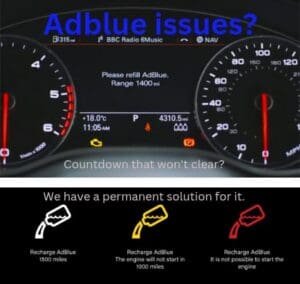
If a NOx sensor gives incorrect readings, the vehicle can decide the emissions system is not working. That can trigger warnings, fault codes, and in some cases a countdown to “start prevented”.
Signs a NOx sensor may be involved
- • AdBlue warning stays on after a proper top-up
- • “SCR system fault” appears with no obvious leaks
- • Warning clears, then returns at random
- • Countdown message starts without warning
- • You were quoted a tank/pump but nothing improved
A NOx sensor fault does not always mean the sensor is dead. It means the readings cannot be trusted until proven.
What NOx sensors do in plain English
NOx sensors measure nitrogen oxides in the exhaust. Most SCR systems use at least one sensor and often two. One reads before the SCR catalyst and one reads after it.
The vehicle uses these readings to decide whether the AdBlue dosing is working. If the readings look wrong, the system flags an SCR efficiency issue and can start protective countdown logic.
How a failing NOx sensor triggers AdBlue faults
The SCR system is judged by results. If the vehicle thinks NOx is not dropping after dosing, it assumes the AdBlue system is not working properly.
- Sensor reads too high. The car thinks emissions are not being reduced, even if dosing is fine.
- Sensor reads erratically. The car sees inconsistent values and logs faults.
- Sensor warms up slowly. This creates a mismatch between expected and actual readings.
- Communication faults. Wiring or module issues make the reading unreliable.
This is why a driver can see an AdBlue warning even with a full tank and no obvious leak.
Common NOx sensor symptoms that get blamed on AdBlue
These symptoms can overlap with tank, pump, and injector issues. The key is confirming the cause, not the message.
Emissions / SCR warning
Often triggered by the system “failing” its own efficiency checks.
Countdown messages
A protection step when the car believes emissions compliance cannot be confirmed.
Repeat faults after parts
Common when a sensor issue was missed and only symptoms were treated.
If your dash message includes “start prevented”, read this too:
AdBlue start prevented message.
How NOx sensor faults are diagnosed properly
A proper diagnosis does not start with “replace the sensor”. It starts by proving the reading is wrong and proving why.
- Read fault codes and freeze-frame conditions.
- Check live NOx values for stability and plausibility.
- Compare before and after sensor behaviour where fitted.
- Check wiring and connectors for corrosion or damage.
- Confirm dosing activity and SCR response where possible.
For a wider look at what we check before repairs, see:
mobile AdBlue diagnostics.
What you should do if you suspect a NOx sensor fault
You do not need to guess. You need a clear test result so you are not replacing parts blindly.
- Stop topping up AdBlue unless the car is genuinely low.
- Take note of the exact message and whether a countdown is active.
- Book diagnostics before agreeing to a tank or pump replacement.
- Ask for live data evidence, not just a fault code printout.
Get the NOx sensor tested before you replace expensive parts
If a NOx sensor is causing AdBlue warnings, we can confirm it properly and clear the issue the right way.
Mobile service across the West Midlands and surrounding areas.
NOx sensor and AdBlue FAQs
Can a NOx sensor cause an AdBlue countdown?
Yes. If the sensor readings make the car think the SCR system is not reducing emissions, the system can trigger a countdown to protect compliance.
Will topping up AdBlue fix a NOx sensor fault?
No. AdBlue level and NOx sensor readings are different issues. A top-up may be needed if the tank is low, but it will not correct bad sensor data.
How do you confirm a NOx sensor is the real cause?
By checking live data for plausibility, comparing expected behaviour, and verifying wiring and SCR response. A proper test proves the reading is wrong and shows why.