AdBlue shelf life is not a marketing figure — it is a chemical one. The fluid manufacturer’s technical data sheet states that at product temperatures between -11 and 25°C, AdBlue has a shelf life of 18 months after production, with a maximum product temperature of 30°C. Read that carefully: the eighteen months is conditional on the temperature, not separate from it. A container that has spent a summer in a van roof rack has not had eighteen months of shelf life. It has had considerably less.
This matters because degraded AdBlue does not look degraded. It stays clear, it pours the same, and it goes into the tank without complaint. The first sign is usually a fault code on a vehicle whose owner is certain nothing is wrong, because they only topped it up last week.
Does AdBlue go off? Yes. Sealed and stored between -11°C and 25°C, AdBlue has a shelf life of around 18 months from production. Heat shortens that sharply, because the dissolved urea decomposes into ammonia and carbon dioxide faster as the temperature rises. Once the urea concentration drifts outside the 31.8-33.2 per cent urea content the ISO 22241 specification allows, the vehicle can log a reductant quality fault.
In this guide
- What the shelf life figures actually say
- What happens to AdBlue chemically as it ages
- Why old fluid triggers a quality fault
- How to store a part-used container properly
- How to tell whether a container is still good
- Frequently asked questions
What the AdBlue shelf life figures actually say
There are two numbers that matter, and they are always quoted together by anyone reading the specification properly.
Eighteen months from date of production, when the fluid is held at product temperatures between -11°C and 25°C, with the maximum not exceeding 30°C. That is the manufacturer’s own figure, and it applies to sealed, unopened product.
The temperature condition is not optional. The shelf life and the storage range are a single statement. Quoting the eighteen months without the temperature band is where most of the confusion on this subject comes from.
In practice, a sealed container kept in a garage or a stores cupboard in the UK will comfortably meet the storage condition for most of the year. A container kept in the back of a working van will not, because the interior of a parked vehicle in direct sun reaches temperatures far above the ambient air.
Freezing is the opposite worry, and it is the lesser of the two. AdBlue freezes at around -11°C. Thawing it does no harm to the fluid, because the water and urea freeze and thaw together rather than separating. Vehicle systems are built on this basis — that is why the tank has a heater in it. Heat is what degrades AdBlue permanently. Cold simply parks it.
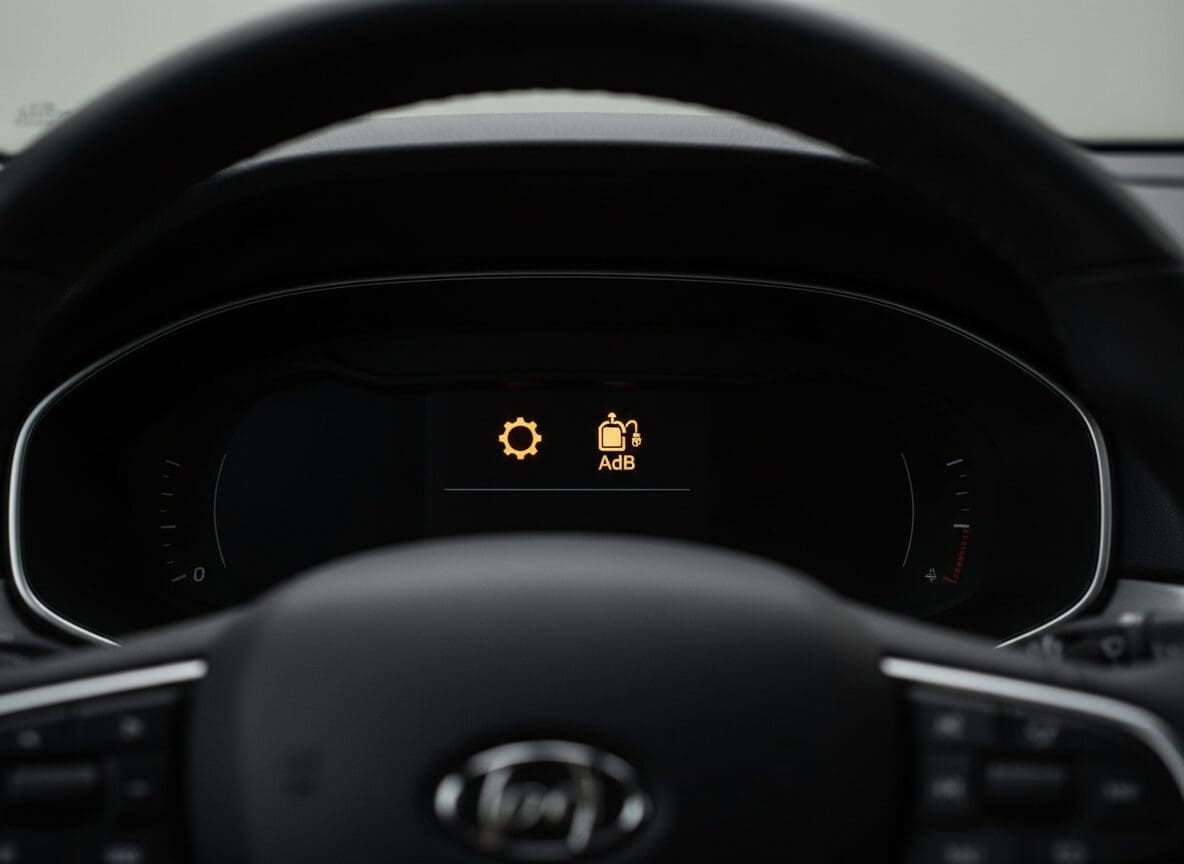
What is actually happening inside the container
AdBlue is urea dissolved in ultra-pure water. The manufacturer’s data sheet is blunt about what that solution does over time: the dissolved urea decomposes slowly even at room temperature, generating ammonia and carbon dioxide, and the rate of that reaction increases when the solution is heated.
Two consequences follow. First, the ammonia leaves the solution, so the urea concentration falls. Second, the fluid becomes more alkaline as it sits — a fresh solution has a pH of roughly 9.0 to 9.5, and stored product can reach around 10.
Neither change is visible. There is no colour shift, no thickening, no smell you would notice through a sealed cap. A container that is two years old and has spent two summers in a warm store can be well outside specification while looking identical to one bottled last month.
The mistake we see most often: an owner keeps a part-used 10-litre container in the van as an emergency top-up, uses it perhaps twice a year, and tops off from the same bottle for three years. That bottle has been opened, warmed, cooled and exposed to air repeatedly. It is the single most likely source of a quality fault on a vehicle that is otherwise mechanically sound.
Why old fluid triggers a reductant quality fault
Modern SCR systems do not measure urea concentration with a laboratory test. They infer it. The NOx sensor downstream of the catalyst reports how much NOx is still in the exhaust after dosing. The ECU knows how much AdBlue it injected, and it knows what reduction that quantity should have achieved. When the measured reduction consistently falls short of the expected reduction, the conclusion the software reaches is that the reductant is not up to standard.
The tell is that a quality fault is almost never instant. It takes a dosing cycle, often several, for the deviation to become consistent enough to set the code — which is precisely why owners connect the warning to whatever they did most recently rather than to the top-up from a fortnight ago.
It is also why the same code can come from a genuinely faulty NOx sensor, a leaking dosing injector or a real fluid problem. The system is reasoning from an outcome, not reading a label. We set out how those causes are separated in our guide to the AdBlue quality fault warning, and how the escalation to a no-restart countdown works in our explanation of the AdBlue system fault warning.
The practical implication is worth stating plainly: if you have a quality fault and you have been topping up from an old container, replace the fluid before you replace any parts. It is the cheapest test available and it rules out the most common cause.

How to store AdBlue so the shelf life means something
Five things, in rough order of how much difference they make.
Keep it out of the sun. Direct sunlight on a container does far more damage than warm ambient air. A shaded shelf beats a sunny windowsill by a wide margin, even in the same room.
Keep it out of the van. The interior of a parked vehicle in summer is the worst storage location most people have available. If you must carry emergency fluid, carry a small sealed container and replace it annually rather than refilling from a large one.
Keep it sealed. Ammonia leaves an open container, and dust and moisture get in. The specification limits contaminants to fractions of a milligram per kilogram, so it does not take much foreign matter to matter.
Use the right container. If you decant, use approved AdBlue containers or stainless steel. Never a used oil bottle, a galvanised can or anything containing copper or brass, all of which react badly with urea solution and will contaminate the fluid.
Note the date. Write the date of opening on the container with a marker. Two years from now that one line will save you a diagnostic bill.
Bulk users and fleets should also be aware that repeated decanting is a contamination route in its own right. A funnel used for anything else, once, is enough. Contaminated fluid also brings its own downstream problem — deposits in the tank and lines, which we cover in our guide to AdBlue crystallisation and what causes it.
Can you tell whether a container is still good?
Honestly, not reliably by eye. That is the uncomfortable answer and it is the correct one.
What you can check: the production or best-before date printed on the container, how long it has been open, and where it has lived. Cloudiness, visible sediment or anything floating in the fluid means discard it without further thought — fresh AdBlue is water-clear. But the absence of those signs does not prove the fluid is in specification, because concentration drift leaves no visual trace.
Refractometers reading urea concentration are available and are what a workshop would use, but for a single container the arithmetic rarely favours buying one. If a container is beyond eighteen months from production, or has been open more than around twelve months, or has spent a summer somewhere hot, the sensible move is to dispose of it properly and start fresh. A new container costs a fraction of the diagnostic time spent chasing a fault it caused.
Where a fault is already logged and the fluid has been renewed without fixing it, the cause is elsewhere in the system, and that is diagnostic work. Our mobile AdBlue diagnostics service reads live dosing and NOx data at your home or yard rather than assuming the fault from the code alone.
Frequently asked questions
How long does AdBlue last once opened?
There is no single published figure for opened containers, because it depends entirely on storage. As a working rule, treat an opened container as good for around twelve months if kept sealed, shaded and cool, and considerably less if it lives in a vehicle. Sealed product is rated at 18 months from production between -11°C and 25°C.
Can you use out-of-date AdBlue?
You can put it in, and nothing dramatic will happen immediately. The risk is that the urea concentration has drifted below specification, which can produce a reductant quality fault after a few dosing cycles. Given the price difference between a container of AdBlue and a diagnostic visit, using questionable fluid is a poor trade.
Does AdBlue go off in the vehicle’s tank?
Far less readily than in a container on a shelf, because the tank is refreshed each time you top up and the system draws from it regularly. The exception is a vehicle that stands for long periods with a part-full tank — low-mileage and seasonal vehicles are more prone to fluid-related faults for exactly this reason.
What happens if AdBlue freezes?
Nothing harmful. AdBlue freezes at around -11°C and thaws without separating or losing quality, which is why vehicle tanks are fitted with heaters. Do not apply direct heat to thaw a container, and allow room for expansion when storing in cold conditions.
Is cheaper AdBlue worse?
Not necessarily — price is not the variable. What matters is that the product is certified to ISO 22241 and that you know how old it is and how it has been stored. A cheap container bought fresh from a high-turnover supplier is a better bet than a premium one that has sat in a warm warehouse for two years.
Quality fault that will not clear after a fresh top-up?
If you have replaced the fluid and the warning is still there, the cause is in the system — a sensor, an injector or the dosing side. We diagnose that at your home or business across the West Midlands and surrounding areas, with live data rather than guesswork.