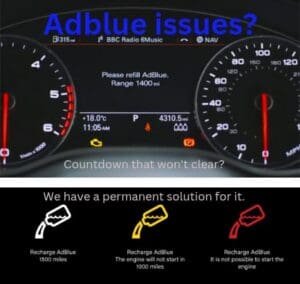
AdBlue warning guide
AdBlue System Fault “No Restart in 600 / 650 / 800 Miles”: Causes and Fix Options
If your dashboard says “AdBlue system fault” and warns that the vehicle will not restart in a certain number of miles, the issue is usually not just low fluid. This guide explains what the message really means, what usually triggers it, and what to do before the countdown reaches zero.
What this warning usually means
When drivers search for adblue system fault no restart in, they are usually looking at a live countdown on the dash and trying to answer one urgent question.
Is the vehicle actually going to stop starting if nothing is done?
In many cases, yes. That is why this message worries so many drivers. It sounds final. It sounds expensive. It often appears even after the tank has been topped up, which makes the whole thing feel confusing and inconsistent.
The most useful way to understand it is this. The warning is the vehicle’s way of saying that the SCR system has detected a fault serious enough that it cannot verify emissions control is working as expected. Once that happens, many vehicles begin a mileage countdown. If the underlying fault remains active and the system does not see a valid repair, the countdown continues.
This article focuses on that exact message and that exact stage of the problem. It is not a general guide to all AdBlue issues. It is about the point where the car or van is warning you that time is running out.
- What the “no restart in X miles” message really means
- Why the countdown starts even when the tank is full
- The most common faults behind the warning
- What happens when the mileage reaches zero
- When resets work and when they do not
- Dealer repair versus specialist mobile diagnostics
- What to do next if the countdown has already started
- FAQs drivers ask before booking help
Quick answer
An AdBlue “no restart in 600 / 650 / 800 miles” message usually means the system has logged an SCR-related fault that has not been properly cleared by a real fix. The cause may be a NOx sensor issue, pump fault, dosing problem, crystallisation, injector issue, wiring fault, or software-related fault. Topping up the tank may help only if the message was caused by low fluid. If the vehicle says “system fault”, the real cause usually needs diagnosing first.
What “AdBlue system fault – no restart in X miles” means
The AdBlue system is part of the wider SCR emissions setup. Its job is to help reduce NOx emissions by dosing fluid into the exhaust process under the right conditions. The vehicle monitors this process using sensors, control logic, and system checks.
If the car sees something that suggests the system is not working properly, it does not always react in the same way straight away. At first, you may only get a warning light or an advisory message. After that, many vehicles escalate to a restart countdown. That is the point where the car is effectively saying, “I still see the fault, and unless it is properly resolved, I will not let this continue indefinitely.”
This is why the message often feels harsh. The driver may still feel the vehicle is running normally. The engine may start, drive, and idle without any obvious drama. Yet the countdown still drops because the issue is emissions-system validation, not just driveability.
The exact number varies by make and model. Some drivers see 600 miles. Some see 650 miles. Some see 800 miles or a metric variation around 1000 km. The number itself is less important than the pattern. It is the same warning logic appearing in slightly different forms.
That distinction matters because many drivers waste time trying the wrong solution. They treat it as a fluid-level problem when it is really a system-confirmation problem.
Low-level message
This usually means the car genuinely wants more fluid. A correct top-up may solve it if there are no other active faults.
System fault message
This usually means the car sees a problem in the SCR system itself. Filling the tank may not change anything.
No restart countdown
This means the fault has escalated and the car is warning that continued non-compliance will lead to a non-start condition.
For broader warning behaviour, see AdBlue countdown warning explained. This page goes deeper into the exact “no restart in” message that drivers type into Google.
Why the countdown appears even when the tank is full
This is one of the most frustrating parts of the whole issue. Many drivers top up the tank as soon as the warning appears, only to find the message stays on the dash. Sometimes the countdown continues to drop. That is usually the moment they realise the problem is not simply the fluid level.
A full tank only solves one possible cause. If the system cannot confirm correct dosing, correct pressure, correct sensor readings, or expected SCR efficiency, the ECU still sees a fault. It is not judging the system by how much liquid is in the tank. It is judging the system by whether it believes emissions control is working.
That is why you can have:
- a full AdBlue tank and an active restart countdown
- fresh fluid added but no change to the dash message
- a recently topped-up vehicle that still logs SCR-related fault codes
- a warning that clears briefly, then returns as soon as the system runs its checks again.
In practice, this often points to one of two things. Either the system has a hardware fault, or it has not completed the conditions needed to accept that the fault is gone. Both matter. Drivers often hear about “resetting” the warning, but a reset without a real repair is rarely reliable. The system needs to see the correct behaviour from the right components.
If you have already topped up and the warning stayed on, it is worth reading AdBlue system reset and what causes AdBlue warning lights and how to fix them. Those pages explain why simple dash-level assumptions often miss the real fault.
The most common causes behind the no-restart warning
There is no single universal cause. Different makes and models fail in different ways. Still, the patterns are surprisingly consistent. The faults below are among the most common reasons drivers end up searching for adblue no restart in 600 miles or similar warning text.
NOx sensor faults
The SCR system depends heavily on accurate NOx readings. If a NOx sensor sends implausible data, responds slowly, or drops out intermittently, the control system may conclude that emissions treatment is not happening correctly. That can trigger warnings, stored codes, and eventually a countdown.
These faults can be especially misleading because the sensor may be the real problem even though the warning appears to point to AdBlue more broadly. For more on this pattern, see NOx sensor causing AdBlue faults.
AdBlue pump or pressure faults
If the pump cannot build the correct pressure, the fluid cannot be dosed as intended. Low pressure, unstable pressure, delayed pressure build-up, or pressure bleeding away too quickly can all cause the system to lose confidence. The driver sees a countdown, but the real issue sits in the pressure side of the dosing setup.
Where this is suspected, AdBlue pump repair is a useful supporting page because it shows how a seemingly simple dash warning can trace back to a specific mechanical fault.
Injector or dosing issues
The fluid may be present, but if it is not being delivered properly, the system still fails its checks. This can happen if the injector is restricted, contaminated, crystallised, or simply not responding as expected. Some vehicles will show efficiency faults before they show obvious dosing-related symptoms, which is why the warning can look vague at first.
Crystallisation in the system
AdBlue crystallisation is common enough that it deserves real attention. White crystal deposits can affect injectors, lines, sensors, and connectors. It is especially common on vehicles that do lots of short trips, repeated cold starts, or interrupted operating cycles. Once the system starts to suffer from build-up, it can behave erratically and throw warnings that seem to come and go.
If that pattern sounds familiar, read AdBlue crystallisation and how short trips cause AdBlue problems. Those pages help explain why the same warning often returns after a temporary improvement.
Tank, heater, or level-sensing issues
Sometimes the system is let down by the tank assembly rather than the fluid itself. Internal sensors, heaters, or module faults can stop the vehicle from trusting the system data it sees. The driver then gets a system warning even though nothing obvious looks wrong from the outside.
Where that is suspected, AdBlue tank repair becomes relevant.
Software-related faults and unsuccessful resets
Not every “no restart in” warning comes from a failed physical part. Some are tied to logic faults, unsuccessful regeneration of system status, previous poor repair attempts, or software behaviour after updates or battery events. That does not mean the answer is always software. It means diagnosis has to be proper. Guesswork here often costs more than the fault itself.
This is one reason drivers end up on pages like AdBlue problems after software update and why AdBlue repairs fail first time. The message on the dash may look simple, but the cause underneath often is not.
What happens when the countdown reaches zero
This is the question nobody wants to test in real life.
On many vehicles, when the countdown reaches zero, the car will not restart after the engine is switched off. That wording matters. The vehicle may still be running right now. You may still be able to drive it. But once you stop and the system sees the countdown has expired, restarting may be blocked.
That is why many drivers get caught out at the worst time. They drive home thinking they have some time left, stop the vehicle, then find the next start attempt fails. Others get into the habit of not switching the engine off, which is not a real solution and can create more problems.
Different vehicles handle this differently. Some become more restricted before total non-start. Some keep the threat until the last moment. Some allow limited restarts under narrow conditions. The only safe assumption is that the warning should be treated as real.
If your vehicle has already crossed into the stage where it says the start is prevented, read AdBlue start prevented message. That page deals with the next stage after the countdown has fully run out.
Practical takeaway
Do not judge the seriousness of the warning by how normally the vehicle seems to drive. A car can feel completely usable and still be only one key cycle away from becoming a non-start once the countdown has expired.
Can the AdBlue restart countdown be reset?
Sometimes yes. Very often, not until the real cause has been dealt with properly.
This is where drivers lose time and money. They hear that the warning can be reset, which is true in a limited sense, and assume that means any diagnostic tool or code clear will solve the issue. In practice, the system usually needs more than that. It needs the fault gone, the relevant values back in range, and the system checks satisfied.
A reset is most likely to work when:
- the original issue was genuinely low AdBlue and has now been corrected
- a real fault has been repaired and the system is now behaving properly
- the vehicle completes the right validation steps after repair.
A reset is much less likely to work when:
- the underlying sensor, pump, injector, or tank fault is still present
- the wiring or signal fault is intermittent
- crystallisation or contamination is affecting operation
- the car has only had codes cleared without fixing the real cause.
That distinction matters because a failed reset often makes the driver think the problem is worse than it is, when really it is just unresolved. Proper diagnosis is what separates a confirmed repair from repeated guesswork.
Dealer repair versus specialist mobile diagnostics
When the countdown begins, many drivers assume the dealer is the only sensible route. Sometimes that is where they start because it feels safest. The problem is that dealer-led routes often follow a more rigid path. Part replacement may come before careful fault isolation, and that can turn a warning-message problem into a much bigger bill.
A specialist mobile approach is often attractive for a different reason. It starts with diagnosis at the vehicle, in the environment where the fault exists, with attention on the actual system behaviour rather than assumptions based purely on message wording.
Dealer route
Often convenient for brand history and warranty logic, but frequently more expensive and less flexible when the vehicle is already showing a time-sensitive countdown.
Mobile specialist route
Useful when you want the fault assessed quickly, practically, and with direct focus on the actual SCR system issue rather than broad workshop process.
Why diagnosis matters first
The warning message on its own does not tell you which component failed. Good diagnosis narrows the problem before money is spent in the wrong place.
If you want to understand the process behind this, see mobile AdBlue diagnostics checks and AdBlue fault diagnosis process.
What to do next if your dashboard already shows the warning
If your dashboard is already showing an adblue system fault countdown, the goal is simple. Avoid wasting the remaining distance on guesswork.
1. Read the exact wording carefully
There is a big difference between “top up AdBlue” and “system fault – no restart in X miles”. The second one points much more strongly toward an active fault rather than a simple refill need.
2. Do not assume topping up will fix it
If the tank is genuinely low, topping up is sensible. But if the system fault remains, the countdown may not change. That does not mean the car is broken beyond repair. It means the problem was never just the fluid level.
3. Avoid repeated code-clearing as a strategy
Repeatedly clearing faults without fixing the cause often wastes time, muddies the picture, and can leave you worse off when the warning returns in the same place or under the same conditions.
4. Get the system checked before the countdown reaches zero
This is the practical step that matters most. The earlier the fault is assessed, the more options you usually have. Once the vehicle becomes a non-start, everything becomes more awkward. Recovery, access, timing, and stress all go up.
5. Use the warning as a timing signal, not just an annoyance
The dash message is telling you the system has reached a point where it wants action. Treating it early is usually cheaper and easier than treating it after immobilisation.
Need the real fault identified before the countdown runs out?
Repair My AdBlue provides mobile AdBlue diagnostics and system solutions across the West Midlands. If your vehicle is showing an AdBlue system fault and a no-restart warning, the priority is to identify the real cause before the vehicle becomes a non-start.
Final thoughts
The key thing to remember is that the “no restart in X miles” warning is rarely just a reminder about fluid. It is usually the result of the system deciding it cannot verify proper SCR operation. That is why the warning can stay even after a top-up. It is also why a generic reset often fails to solve it.
If you have seen 600 miles, 650 miles, 800 miles, or a metric equivalent, treat the number as a countdown to action, not just a dashboard nuisance. The earlier the cause is properly identified, the better the chance of resolving it before the situation becomes a non-start problem.
If you want a broader overview of related symptoms and repair paths, complete guide to AdBlue problems 2026 is a useful next read. If you already know you need help, go straight to Contact Us or review the available options on the services page.
AdBlue no restart warning FAQs
Why does my car say AdBlue system fault no restart in 600 miles?
This usually means the SCR system has detected a fault serious enough that the vehicle has started a restart countdown. The issue may be sensor-related, pressure-related, dosing-related, or linked to crystallisation or software behaviour. It does not always mean the tank is empty.
Can I drive with an AdBlue no restart warning?
Usually yes, at least for a while, but that is not the same as being safe to ignore it. Many vehicles will continue to run until the countdown expires, then refuse to restart after the engine is switched off.
Will topping up AdBlue clear the no restart countdown?
Only if the warning was caused by genuinely low fluid and there are no other active faults. If the message says “system fault”, topping up alone often will not clear it.
Can the AdBlue restart countdown be reset?
It can be reset in some cases, but reliable results usually depend on the underlying fault being repaired first. Clearing codes without fixing the cause often leads to the warning returning.
What is the best next step if I see this warning?
Get the vehicle properly diagnosed before the countdown reaches zero. That gives you the best chance of avoiding a non-start situation and wasting money on parts that do not solve the actual issue.