
Peugeot & Citroën AdBlue Fault: P20EE, Tank Issues & Fixes Explained
Peugeot and Citroën vans are among the most common Euro 6 commercial vehicles on UK roads. When the PSA platform AdBlue system develops a fault, it causes warning lights, fault codes, and eventually a no-start countdown. This guide explains what causes Peugeot and Citroën AdBlue faults and what your real options are.
The PSA platform — the shared engineering base underneath Peugeot, Citroën, and related commercial vans — powers some of the UK’s most popular working vehicles. The Peugeot Expert, Peugeot Boxer, Citroën Dispatch, and Citroën Relay are all built on this platform, and all Euro 6 versions run an AdBlue SCR system. When that system develops a fault, the vehicles generate the same class of warnings: P20EE fault codes, SCR inefficiency flags, and — if left untreated — a countdown to the engine refusing to restart.
We work on PSA platform vehicles regularly. This guide covers the specific faults, codes, and causes you’re likely to encounter, and explains what a practical fix looks like for a Peugeot or Citroën van.
PSA Platform Vehicles and Their AdBlue Systems
The PSA Group (now part of Stellantis) produces several Euro 6 commercial vans that share core engine and emissions technology. The most common in the UK are:
- Peugeot Expert — medium panel van, 2.0 BlueHDi engine
- Peugeot Boxer — large panel van and chassis cab, 2.2 BlueHDi engine
- Citroën Dispatch — medium panel van, same 2.0 BlueHDi as the Expert
- Citroën Relay — large van, same 2.2 BlueHDi as the Boxer
- Toyota ProAce — medium van, built on the same platform as the Expert/Dispatch
- Fiat Scudo / Talento — related platform variants from Fiat
All of these run the SCR (Selective Catalytic Reduction) system that injects AdBlue into the exhaust stream to reduce NOx emissions. The system is governed by a dedicated AdBlue control module that communicates with the main ECU and monitors fluid level, pump pressure, NOx sensor readings, and catalyst efficiency.
PSA’s AdBlue implementation has some platform-specific characteristics. The 2.0 BlueHDi in the Expert and Dispatch uses a relatively compact SCR setup with the AdBlue tank typically located in the engine bay. The 2.2 BlueHDi in the Boxer and Relay uses a larger system with the tank often sited near the chassis. The fault patterns are similar across both, but the layout affects how faults are diagnosed and what components are accessible.

Warning Messages on Peugeot and Citroën Vans
The dashboard language used by PSA vans for AdBlue warnings varies slightly between model year and trim level, but the progression is consistent:
First warning — low AdBlue level
Typically displayed as “Add AdBlue: Engine may not restart” or a yellow AdBlue gauge warning. This appears at around 10–15% tank capacity. The vehicle continues to operate normally at this stage. Refilling the tank with ISO 22241-compliant AdBlue should clear this warning once the level sensor confirms adequate fluid.
Second warning — system fault detected
More serious than a level warning. Messages like “AdBlue system fault”, “Emission system fault”, or “SCR system fault — see dealer” indicate a component problem rather than just low fluid. A fault code will have been stored in the ECU. At this point, a countdown to engine restriction begins. Simply topping up won’t help.
Third warning — engine restart warning
As the countdown approaches zero, the instrument cluster will display increasingly urgent messages about the engine not restarting after the current journey. The final warning before lockout is usually very direct: the vehicle will not restart after you switch it off.
Don’t let the countdown run out
Once a Peugeot or Citroën van enters the no-restart phase, it won’t start again until the ECU confirms the AdBlue fault is resolved. If you’re currently at the countdown stage, call us before parking the vehicle for what could be its last start.
Understanding the P20EE Fault Code
P20EE is the OBD2 fault code for “SCR NOx Catalyst Efficiency Below Threshold”. It’s one of the most commonly stored codes on PSA platform vans with AdBlue faults, and it’s also one of the most misdiagnosed.
The code tells you that the ECU has detected the SCR catalyst is not reducing NOx to the required standard. But there are multiple reasons why this can happen:
- The SCR catalyst is genuinely degraded — particularly on high-mileage vans. If the catalyst honeycomb has deteriorated, it can’t process AdBlue effectively.
- The upstream or downstream NOx sensor has failed — if either sensor is reading incorrectly, the ECU can’t verify catalyst efficiency even if the catalyst itself is fine. This is a very common cause of P20EE.
- The AdBlue dosing system is underperforming — if the pump isn’t delivering enough fluid, or if the injector is partially blocked, the AdBlue concentration in the exhaust is too low to achieve the required NOx reduction.
- Contaminated or diluted AdBlue — using poor-quality fluid or water can mean the urea concentration is too low to work properly.
This is why reading the fault code alone isn’t enough. You need live NOx sensor data, pump pressure readings, and fluid quality assessment to work out which of these causes is actually triggering the P20EE. Without that, replacing the catalyst on a hunch could cost over £1,000 and leave the same code present because the sensor was the real problem all along.
Common PSA AdBlue Fault Causes
Based on the vans we work on, these are the most frequent fault patterns on Peugeot and Citroën Expert, Dispatch, Boxer, and Relay vans:
NOx sensor failure (upstream or downstream)
The NOx sensors on PSA 2.0 and 2.2 BlueHDi engines are known to have a finite lifespan. Downstream sensors tend to fail more frequently than upstream sensors on these engines, though both can be affected. Sensor replacement resolves the P20EE code when the sensor is the actual cause, and it’s a substantially cheaper fix than catalyst replacement.
AdBlue pump wear or blockage
The dosing pump on PSA vans sits in or near the AdBlue tank and can develop wear or AdBlue crystallisation blockages over time — particularly if the vehicle has stood unused for an extended period and residual fluid has dried and crystallised in the lines or pump housing.
AdBlue quality or contamination
PSA vans are sensitive to AdBlue quality. Using non-ISO-compliant fluid, even once, can trigger P207F (reductant quality) codes and secondary damage to the dosing system. If diesel or another fluid has entered the AdBlue tank, a full drain, flush, and refill is required before the system will function correctly.
SCR catalyst degradation
On vans with very high mileage — typically 150,000 miles or more — the SCR catalyst itself may have deteriorated to the point where it can no longer achieve required NOx reduction efficiency. This is often the last cause to consider, after sensors and dosing have been ruled out, because it’s also the most expensive to fix through hardware replacement.
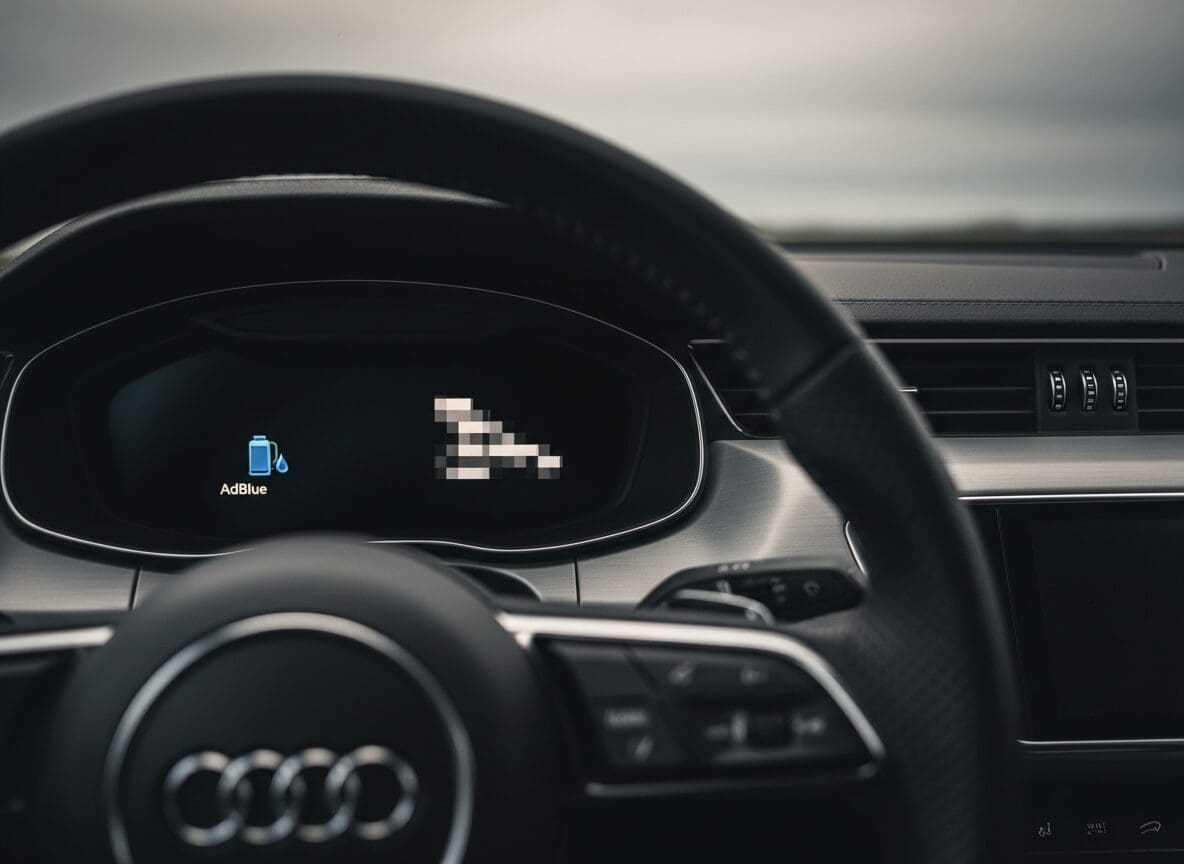
AdBlue Tank and Pump Faults on PSA Vans
The AdBlue system on Expert/Dispatch models keeps the tank in the engine compartment, which means it’s exposed to engine heat and can experience thermal stress over time. The 2.0 BlueHDi tank assembly includes the level sensor, heating element, and pump as a single integrated unit on some variants — which means a failure of one component can lead to replacement of the whole assembly rather than just the faulty part.
On the Boxer and Relay, the tank is typically in a more sheltered position, but the pump and heater element are still points of failure. Cold weather crystallisation is a recurring issue on these larger vans because the higher tank capacity means there’s more surface area for crystals to form if the heating system doesn’t work correctly.
Warning: don’t keep refilling if the tank shows full
If the AdBlue warning remains despite the tank reading full, this is a system fault — not a fluid level problem. Continuing to add AdBlue won’t help and risks overfilling. Get the fault codes read first.
Fix Options: Hardware Repair or Software Delete?
For Peugeot and Citroën van operators facing AdBlue faults, the practical decision usually comes down to two routes:
Hardware repair
Appropriate when the fault is clearly isolated to a single, replaceable component — typically a NOx sensor or a faulty level sensor. NOx sensor replacement on PSA vans typically costs £180–350 fitted. If the pump assembly or SCR catalyst needs replacing, costs escalate significantly: pump replacement can run to £400–700, and catalyst replacement on the Boxer or Relay can exceed £1,200–1,800 fitted by an independent specialist.
Software-based AdBlue delete
A software solution reprograms the ECU to remove the AdBlue system from the vehicle’s operational logic. The system stops monitoring AdBlue, stops generating fault codes, and the vehicle operates as normal without requiring the fluid. This is particularly relevant for PSA vans where the integrated tank/pump assembly makes component replacement expensive, or where high mileage makes investing in a new SCR catalyst commercially impractical.
Our mobile service covers Peugeot Expert, Peugeot Boxer, Citroën Dispatch, and Citroën Relay across the West Midlands and UK. We come to you, complete the work at your location, and the vehicle is operational immediately afterwards. Most PSA platform jobs take two to three hours.
Not sure which route is right for your van?
We offer a free consultation before any work begins. Tell us what warning messages you’re seeing and what fault codes have been read, and we’ll give you an honest assessment of which option makes the most commercial sense for your vehicle. Get in touch here.
Peugeot or Citroën AdBlue fault? We can help.
We’re a mobile AdBlue specialist covering the West Midlands and beyond. We diagnose and fix PSA platform AdBlue faults — at your location, with upfront pricing.
Frequently Asked Questions
What does P20EE mean on a Peugeot or Citroën van?
P20EE means “SCR NOx Catalyst Efficiency Below Threshold.” It indicates the AdBlue system isn’t reducing NOx emissions to the required level. The cause could be a failed NOx sensor, a degraded SCR catalyst, a faulty dosing pump, or poor AdBlue quality. A proper diagnosis with live data is needed to identify the actual cause before spending money on parts.
Does the Citroën Dispatch have the same AdBlue system as the Peugeot Expert?
Yes. The Dispatch and Expert are built on the same EMP2 platform and share the same 2.0 BlueHDi engine and SCR system. Fault patterns, codes, and fix options are effectively identical across both models.
How long will the van keep running after an AdBlue fault warning?
It depends on the stage of the warning. An early system fault warning may give you dozens of starts before the restriction kicks in. Once you see the “engine will not restart” message, you’re on your last start. Don’t rely on guessing how many starts you have left — get the fault addressed.
Can a Peugeot Boxer AdBlue fault be fixed without going to a dealer?
Yes. We work on Boxer and Relay models regularly as a mobile independent specialist. We can carry out diagnostics, component replacements (where appropriate), and software solutions — at your location, without the need for a main dealer booking.
Will a software delete affect my van’s performance or fuel economy?
No. A software-based AdBlue delete removes the AdBlue system monitoring from the ECU. The rest of the engine management mapping remains unchanged. In practice, most operators notice no difference in performance or fuel consumption after the fix.


