
The Mitsubishi L200 is one of the UK’s most capable pickup trucks. From 2019 onwards, the Series 6 model uses a Selective Catalytic Reduction (SCR) system requiring AdBlue to meet Euro 6 standards. When that system detects a problem, a warning message appears on the dashboard. In more serious cases, a countdown begins telling you the engine will not restart.
If your L200 is showing a Mitsubishi L200 AdBlue fault or a “system service required, no restart in X miles” warning, this guide explains what is happening, why it happens, and what your options are.
Quick answer: What does the Mitsubishi L200 AdBlue fault mean?
A Mitsubishi L200 AdBlue fault and “system service required, no restart” message means the SCR emissions system has detected a problem it cannot resolve. The most common causes are a faulty NOx sensor, a blocked AdBlue injector, an AdBlue pump issue, or a level sensor fault. Simply refilling the AdBlue tank will not clear a system fault — the vehicle needs a diagnostic scan and targeted repair.
- How the L200 AdBlue system works
- The most common causes of the fault
- Why the no-restart countdown appears
- What not to do when the warning shows
- Your repair and resolution options
- Frequently asked questions
How the Mitsubishi L200 AdBlue system works
The Series 6 L200 uses a 4N15 2.4-litre diesel engine paired with an SCR aftertreatment system. AdBlue — a precisely formulated solution of urea and deionised water — is stored in a dedicated tank and injected into the exhaust stream, where it chemically converts harmful nitrogen oxides (NOx) into nitrogen and water vapour.
According to Mitsubishi’s official L200 Series 6 owner documentation, the AdBlue tank holds 21 litres and should cover approximately 12,000 miles before requiring a refill under normal UK driving conditions.
The system involves multiple components working in sequence: a dosing pump, an injector positioned in the exhaust, NOx sensors upstream and downstream of the SCR catalyst, a combined level and temperature sensor inside the tank, and ECU logic that monitors and regulates the entire process. If any part of this chain produces a reading the ECU cannot trust, the result is a stored fault code — and the warning messages that follow.
The most common causes of the Mitsubishi L200 AdBlue fault
1. Faulty NOx sensor
NOx sensor faults are one of the most common causes of AdBlue system warnings across Euro 6 diesel vehicles. The sensor monitors exhaust gas composition and feeds data to the ECU. If it produces an implausible reading — or fails to send data at all — the ECU cannot verify that emissions reduction is working, triggering a stored fault and often the start of a countdown.
2. Blocked or failed AdBlue injector
AdBlue crystallises when exposed to high heat, and the dosing injector sits directly in the exhaust where temperatures are considerable. Short-trip driving is a particular risk factor — the system does not always get hot enough to fully purge the injector, and crystalline deposits build up over time. A blocked injector disrupts the dosing pattern and triggers SCR efficiency warnings.
3. AdBlue pump underperformance or failure
The pump pressurises the AdBlue and delivers it to the injector at the precise rate the ECU demands. A failing pump may struggle to build consistent pressure, producing intermittent fault codes. Some L200 owners report no codes at all in the early stages — the fault only becomes clear when the system is tested under load with specialist diagnostic equipment.
4. Level or temperature sensor fault
The sensor module inside the AdBlue tank monitors both fluid level and temperature. If it reports an incorrect level — showing empty when the tank is full, for instance — the system may not dose at all, and a low-fluid warning may persist even after topping up.
5. Software or calibration issue
Some L200 owners have encountered AdBlue fault messages with no identifiable hardware fault behind them. Mitsubishi has issued software updates for SCR-related issues across diesel models. If a diagnostic scan finds no hardware fault codes, a software check is worth requesting before replacing any components.

Why the “no restart in X miles” countdown appears on the L200
The countdown message is the vehicle’s driver inducement system in action. Under Euro 6 regulations, manufacturers are required to implement measures that restrict or prevent vehicle operation if the emissions control system is not functioning correctly.
Once triggered, the AdBlue no-restart countdown does not stop on its own. It counts down with each drive cycle. When it reaches zero, the engine will complete that journey but will not restart after the next key-off. This is a software enforcement, which means it requires a software-level reset alongside the underlying repair.
What not to do when the AdBlue fault appears on the L200
- Do not just top up and wait: If the warning is a system fault, refilling the tank will not clear it. The fault code remains active until the underlying problem is resolved.
- Do not keep driving indefinitely: The countdown is real. The closer it gets to zero, the fewer practical options you have for getting the vehicle to a repair point under its own power.
- Do not attempt to reset it with a standard OBD reader: Basic code scanners can read fault codes but cannot perform the SCR-specific adaptive resets required to release the no-restart countdown on the L200. Clearing codes without resolving the fault usually results in the same warning appearing within a short distance.
- Do not replace parts without diagnosing first: Main dealers often change the whole AdBlue system as a default. Independent specialists can usually identify the specific failing component, which means only that component gets replaced.
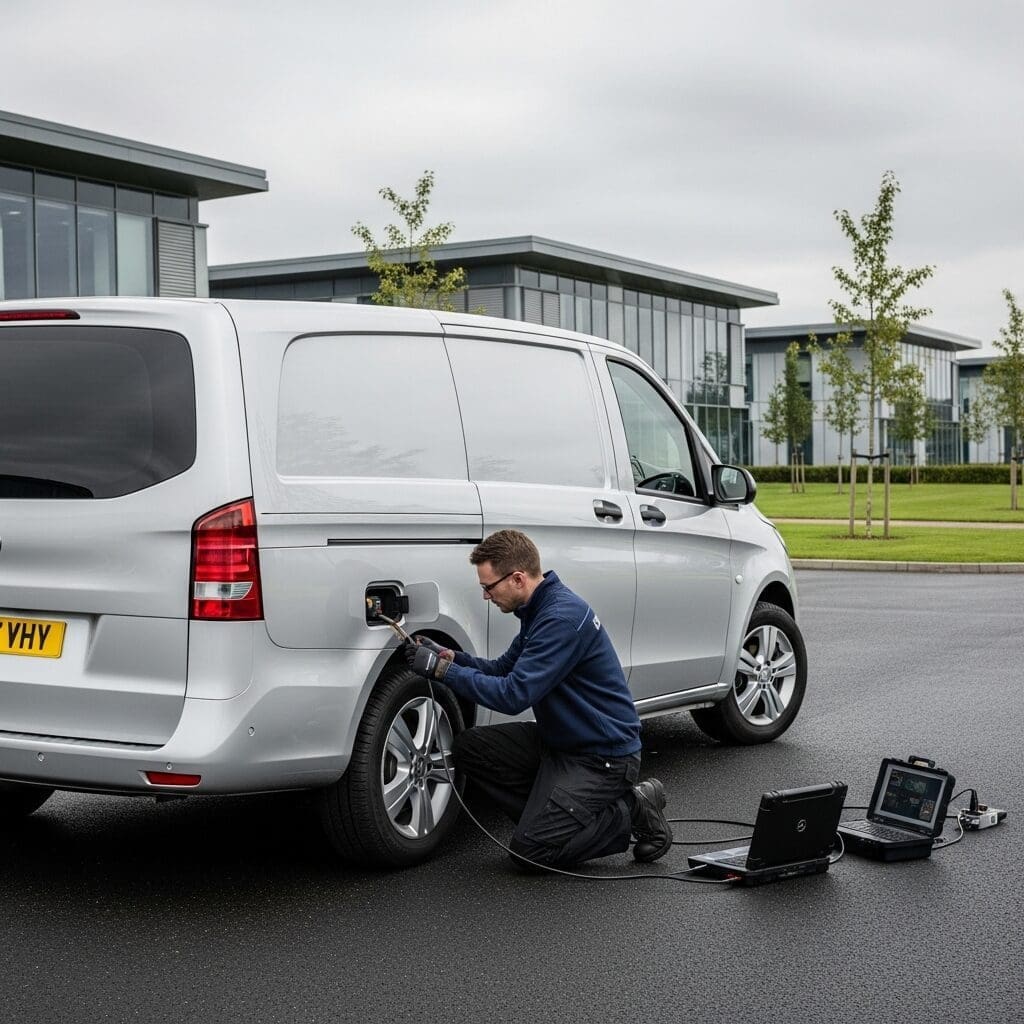
Your options for fixing the Mitsubishi L200 AdBlue fault
Targeted component repair or replacement
Once diagnosed, the specific failing component — NOx sensor, AdBlue injector, pump, or tank sensor — can be replaced and the system reset. A specialist with the right diagnostic tooling can confirm which part is at fault rather than defaulting to a full system swap. This is usually faster, more affordable, and more reliable.
Software update or ECU reset
Where the fault is software-related, an updated ECU calibration can resolve the issue without touching any hardware. A diagnostic reset of the SCR system is required alongside any repair to release the countdown.
AdBlue delete — permanent software solution
For L200 owners who want to eliminate AdBlue fault issues permanently, our mobile AdBlue delete service removes the SCR system dependency from the ECU entirely. The truck operates normally — without AdBlue warning lights, pump failures, injector blockages or countdown messages reoccurring. All work is carried out at your location.
L200 AdBlue fault? We come to you.
We diagnose and fix Mitsubishi L200 AdBlue system faults at your location across the Midlands and beyond — no recovery truck, no dealer waiting list.
Frequently asked questions
What does “AdBlue system service required, no restart” mean on a Mitsubishi L200?
It means the vehicle’s SCR emissions system has detected a fault it cannot resolve on its own. The countdown tells you how many miles remain before the engine will refuse to restart after the next key-off. This is a system-level fault — it requires diagnosis and repair, not a fluid top-up.
Can I still drive my Mitsubishi L200 with an AdBlue fault?
You can continue driving while the countdown is active, but you should treat it as urgent. Once the countdown reaches zero, the engine will complete that drive cycle but will not restart when you next turn the key. Do not wait until the final miles to seek a fix.
How much AdBlue does the Mitsubishi L200 Series 6 hold?
The Series 6 L200 has a 21-litre AdBlue tank, which Mitsubishi says covers approximately 12,000 miles under normal driving conditions. If you are refilling more frequently, it may indicate excessive consumption or a dosing system fault.
Will topping up AdBlue clear the system fault warning on the L200?
No. If the warning is a system fault rather than a low-level alert, refilling the tank will not clear it. The fault code remains active until the underlying issue — NOx sensor, injector, pump, or software — is properly addressed.


